Trees for urban landscapes
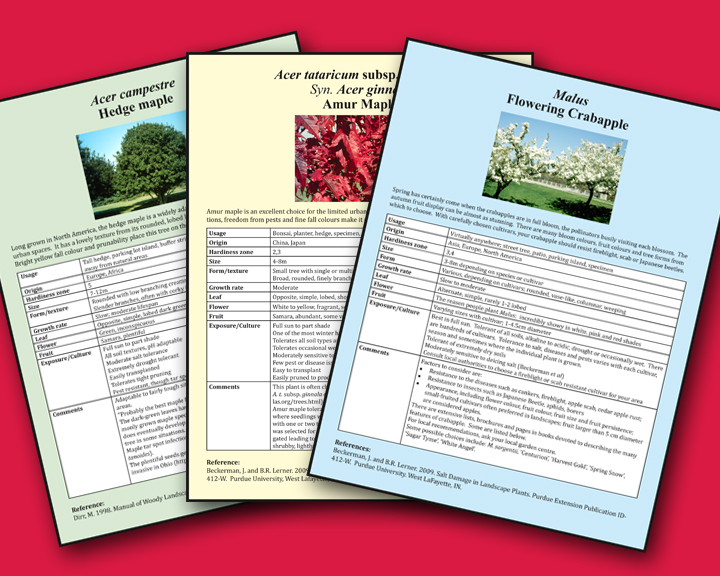
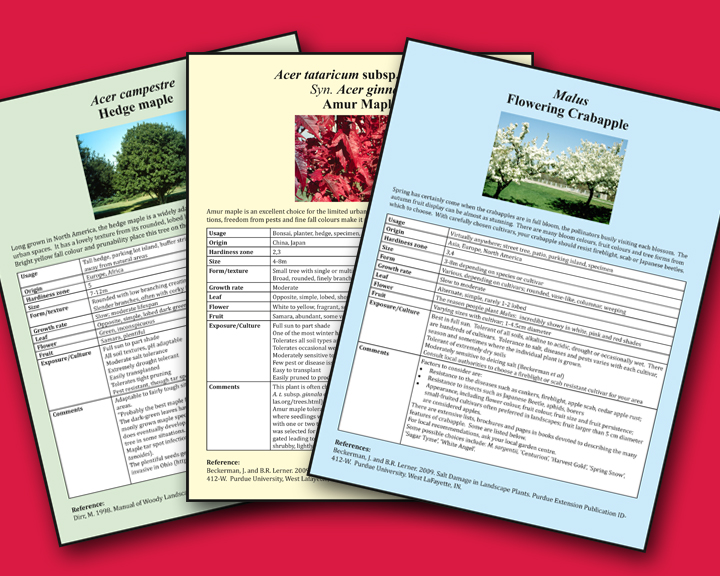 These handy fact sheets profile individual tree specimens and help you to choose the right tree for the right location.
Click on a link to view the fact sheet on that particular species.
Acer campestre – Hedge Maple
Acer tataricum subsp. ginnala – Amur Maple
Acer platanoides – Norway Maple
Acer triflorum – Three-flowered Maple
Acer xfreemanii – Freeman Maple
Aesculus flava – Yellow Buckeye
Amelanchier – Serviceberry
Carya cordiformis – Bitternut Hickory, Swamp Hickory
Carya ovata – Shagbark Hickory
Celtis occidentalis – Hackberry
Fraxinus quadrangulata – Blue Ash
Ginkgo biloba – Ginkgo, Maidenhair Tree
Gleditsia triacanthos – Thornless Honeylocust cultivars
Gymnocladus dioica – Kentucky Coffeetree
Maclura pomifera – Osage Orange
Malus – Flowering Crabapple
Ostrya virginiana – Ironwood or Hop-Hornbeam
Phellodendron amurense – Amur Corktree
Pyrus calleryana – Callery Pear
Quercus bicolor – Swamp White Oak
Quercus ellipsoidalis – Northern Pin Oak, Hill’s Oak
Quercus macrocarpa – Bur Oak
Quercus muehlenbergii – Chinquapin Oak
Quercus shumardii – Swamp Red Oak, Shumard’s Oak
Syringa reticulata cvs – Japanese Tree Lilac cultivars
Taxodium disticum – Baldcypress
Tilia americana – Basswood
Tilia cordata – Littleleaf Linden
Ulmus americana – American Elm, White Elm
 |
This project was funded in part through Growing Forward, a federal-provincial-territorial initiative. The Agricultural Adaptation Council assists in the delivery of several Growing Forward programs in Ontario. |