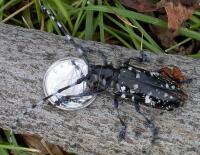
 More than 150 people attended an information meeting hosted by the Canadian Food Inspection Agency, in cooperation with Landscape Ontario, to explain the full implications to the landscape, retail and nursery industry of the Ministerial Order now in place to prevent the further spread of the Asian long-horned beetle (ALHB). The following is a summary of the meeting held March 23, 7 p.m. at the Doubletree International Plaza Hotel.
The new regulations in place to prevent the further spread of ALHB will have an impact on all horticultural companies that do business in or near the regulated area. Anyone not familiar with the details of the Ministerial Order, the perimeters of the regulated areas within Toronto and Vaughan, or the complete list of host species affected by ALHB should refer to the CFIA website There is a picture of an adult beetle on the home page; just follow the links. A Question and Answer sheet was developed by CFIA to address some of the most common questions asked by industry. It is attached at the end of this article.
The ALHB is a very destructive pest, with serious economic implications to the nursery, forestry, maple syrup industries and many more. This insect is regulated around the world. Based on the limited successes being realized in most US cities with infestations, CFIA has made the decision to adopt a very aggressive eradication program. Their program is on target; to date over 10,000 trees have been destroyed and the initial tree removal strategy will be completed by their projected date of March 31.
Impact to the landscape construction sector
There is no restriction of movement on plants into the regulated area. However, the CFIA’s eradication strategy calls for the removal of all host plants within 400 metres of an infested tree. Even newly planted host trees, such as maple or horse chestnut, would be destroyed if it happened to be within the zone. It is therefore strongly recommended that landscape contractors advise their customers to choose plants that are not on the host list.
Impact to the grounds management sector
The regulation affects the movement of all debris of all hardwood trees and all firewood, regardless of species. Debris can not be moved out of the regulated area. Larger quantities of debris should be taken to regulated disposal sites; smaller quantities of debris can be left at the curbside for pick-up by city crews.
At the moment, the Toryork yard is the only disposal site within the regulated area. CFIA, City of Vaughan and City of Toronto officials are trying to find other disposal sites. These new locations will be communicated to Landscape Ontario members by e-mail and through the website, as they become available.
Impact to retail garden centres
The largest impact of the Ministerial Order will no doubt be felt by retail garden centres located within the regulated area. There is no restriction of movement within the regulated area. All retailers, located within or near the regulated area should discourage customers located within the regulated area from purchasing trees on the host list, to prevent newly planted trees or shrubs from being destroyed in the event it is located near a positive find.
Host materials can not be moved from the regulated area unless accompanied by a Domestic Movement Certificate. These are available from the CFIA — see below for details. Every host plant to be moved out of the area will require a Domestic Movement Certificate. If the event that host trees are returned to garden centres outside the regulated area from inside the regulated area, the garden centre is requested to call CFIA for removal and destruction of these materials.
CFIA has indicated they will work with retailers in the regulated area who wish to develop a program for the sale of host materials from secure, protected environments. Interested retailers should submit a proposal to CFIA, Plant Protection Division; call 416-665-5055 for further information.
Impact to nursery growers
The largest impact will be to growers that provide drop shipments to customers within and near to the regulated area. Host materials can not move into and then out of the regulated area without a movement certificate. It is therefore recommended that if shipments do contain host materials, they be organized so that the first drops are outside and the last drops are inside the regulated area.
It had originally been suggested by CFIA that a Domestic Movement Certificate would be required for all host materials moving through the regulated area. This recommendation has since been amended; host materials are permitted to move through the regulated area provided the truck makes no stops within the area.
Domestic Movement Certificates
Domestic Movement Certificates can be obtained from the Plant Protection Division of your local CFIA office. In Toronto call 416-665-5055. Please be explicit about the nature of your call and you will be forwarded to the proper person or department.
Cost of Domestic Movement Certificates is as follows:
For orders valued over $1,600
$17 Certificate Fee
$50 Inspection Fee
For orders valued under $1600
$ 7 Certificate Fee
$ 5 Inspection Fee
Depending on the time of year and volume of work, expect to wait 24 to 48 hours for an inspector. Certificates expire within 14 calendar days (10 business days.)
Waste Disposal
At the current time, there is only one disposal site within the regulated area. CFIA recognizes the importance of opening more sites and are working with the City of Vaughan and Toronto to find alternative locations. Details will be provided to industry by Landscape Ontario.
The current waste disposal site is located at:
Emery Yard, 27 Toryork Drive, one block north of Finch at Weston Rd.
Further inquiries re: waste disposal can be directed to:
Toronto: 416-338-2010
Vaughan: 905-832-8577, ext. 6137
General Information:
Chipping of waste product
According to CFIA, it has been scientifically proven that chipping of waste product to 5/8” or less means the ALHB is totally destroyed. This chip size is difficult to achieve with standard chipping equipment; all materials are being further ground with tub grinders. CFIA are currently investigating options for disposal of the huge amount of wood waste that has been generated by their eradication program, including burning for steam and various manufacturing alternatives.
Tree replacement program
The government of Ontario recently announced it would provide $1 million for replanting of trees destroyed as a result of the Emerald Ash Borer and Asian Long Horn Beetle eradication efforts. These monies will be divided between the two areas, full details of the replanting programs are not yet available.
Communication
Despite CFIA’s massive communication’s efforts, there continue to be people living inside the area not fully aware of the implications of this pest or the regulations in place to control its further spread. With the large numbers of people soon to be visiting garden centres, etc. industry assistance is being solicited. Further information materials are currently being developed by CFIA and will be made available to industry for garden centre distribution, etc. Please refer back to the LO website for ongoing information in this regard.
Penalties for non-compliance
While federal regulations allow for jail time as well as fines of up to $250,000 in the event of non-compliance with Ministerial Orders, to date no one has ever been sent to jail. Fines as high as $150,000 per incident have been levied for serious breaches of similar Ministerial Orders.

