
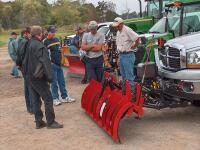
 The LO Snow and Ice Commodity Group held its annual Snow and Ice Symposium on Sept.12 at Landscape Ontario. This year, Dale Keep of Ice and Snow Technologies in Walla Walla, Wash. was the guest speaker. Keep has many years of experience with severe winter conditions and before starting his consulting business, was in charge of snow and ice control for the state of Washington. Keep’s presentation was on the Theory and Practice of Snow and Ice Control Chemicals.
The biggest challenge in snow and ice control today is breaking old habits, Keep said, noting that a plow is a tool and an option to use when other snow and ice management tools have failed. There are lots of new tools and technologies and operators need to understand the tools and how to use them. Only a few in the 90-member audience said they used liquid technology, but Keep reminded them that using de-icers is using a liquid, as the products must take up water and dissolve to work in solution. “You may have handled solids, but you used liquids. Chemicals are totally predictable,” he explained. “If you apply them and they don’t work, you screwed up.” Keep also recommended the use of liquids because operators can place them where they want them, when they want them, in the quantity required, and product can’t be displaced by bouncing or scattering from road traffic.
Keep didn’t recommend specific products. “The best de-icing product is the one that meets your requirements. They are all the best somewhere, but none of them are best everywhere,” he said.
Admitting old habits are hard to break, Keep discussed anti-icing as a proactive approach to winter storms and de-icing as a reactive treatment applied to the top of snow and ice accumulations. Even if an anti-icing product is applied, snow and ice can still form on top of the road, but the bond between ice and pavement will be softer and easier and faster to break. The keys to success are good site monitoring and record keeping (so you know what worked and what didn’t) as well as crew education and training. Keep is convinced that with careful monitoring, operators can decrease their application rates and increase their profitability and customer satisfaction.
Heather McClintock of Ontario’s Ministry of Transportation gave an update on the ministry’s tendering process as well as new snow and ice monitoring and control technology with which the MTO is experimenting.
Concise records are an important part of snow and ice risk management and global positioning systems (GPS) can be used to monitor and record weather conditions and amount of product applied at a certain time and date at a specific location. Bob Farell of PinPoint GPS Solutions spoke about the concise and automatic records that can be collected with the use of GPS. Farell says that by collecting detailed and accurate information, operators can reduce their liability with slip and fall claims by proving they fulfilled their contractual obligations to the letter.
The importance of a well-crafted contract and good record keeping was addressed by Horticulture Review columnist Robert Kennaley, a lawyer and former landscape contractor. Kennaley was instrumental in developing LO’s standard snow and ice removal contract (available at
www.horttrades.com under the Resources tab). His message was that snow and ice contractors leave themselves open to lawsuits when they perform work not specified in their contracts. Kennaley’s number one recommendation is to always provide your own contract and to “stop promising the impossible.” He said that a contract that specifies “X Company will keep the premises free of snow and ice” is impossible to fulfill and asked operators to think about what they are promising in their contracts, and how they are going to fulfill the promises.
In the case of a slip and fall claim, operators need to show the insurance adjuster and lawyer what they were hired to do (through a contract) and what they did (through impeccable records).
