
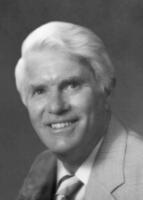
LIFE IS A JOURNEY – Tribute written and delivered by son Gordon Shuttleworth, past president of Landscape Ontario
I would like to share with you a brief history of Ted’s Journey
James Edgar Shuttleworth was born in Kingston, ON on April 14, 1915
Ted’s father was a Captain in the 18th Battalion Infantry, and was stationed in Quebec preparing to go overseas for war, when Ted was born. He took a day’s leave of absence to travel to Kingston, to see his first-born. After one day at home he had to return to Montreal to board a ship to the leave for the war in Europe. Ted was the oldest from a family of five children and had three sisters and one brother.
After the war his parents settled in London, ON, in a home his father built on Commissioners Rd.
As a child, Ted grew up in a home business and attended Brick Street Public School and went on to attend Central Secondary School. After some years of high school, he left school to work with his father in his Sun Helmut business called Shuttleworth Hat Manufacturing.
Not wanting to work indoors all the time, Ted started to take an interest in budding fruit trees and growing grapes for the London Winery with his father. This was the beginning of his passion to work on the land and grow plants.
He met his sweetheart for life, Gladys at Calvary United Church on Garfield Ave. in south London, and after a few years of courting they married on December 18, 1937; they celebrated their 65th Anniversary this past December. They began a life together as a team working and creating a family and building a business called Little Tree Farm.
Their first house was a log cabin made from telephone poles and was situated on the corner of Wonderland Rd. and Springbank Dr. That same log cabin is still standing as a garden shed in Kensal Park, not far from us here today.
During the war years, they grew vegetables, raised chickens and pressed and sold apple cider. After the war was over they added nursery stock to their list of income producing plants by growing and selling fruit trees for $.25 each. The family had expanded to three children, and the lean-to rooms built onto the cabin were becoming a little cumbersome. So, house number two was built on their land next to number one. More long nights… buying used lumber and building and hammering many nails – and a complete six-room house was constructed.
Ted prospered in the Spring and Summer months, but due to the limited growing season for nursery stock, he had to find other jobs in the winter to keep the cash flow coming in. Dad worked in a machine shop called Carsons on Hamilton Rd., where he learned fabrication of machinery and equipment, which benefited him later in building and mechanizing his own nursery business.
As success came their way they expanded by purchasing more land and building a packing shed at 460 Springbank Dr. to store and process the vegetables they grew; they rented out the rest of the land to a cabbage grower.
During the next few years they were able to begin planting small seedling nursery stock imported from Holland, They sold their land and second home down the road, and the packing shed then became their third home.
On the front of their third home they built two greenhouses to grow flowers to sell along with their nursery stock.
Rather than work for the machinery shop in the winters, Dad designed and created a process to manufacture concrete patio stones, and sold them in the summer months from their fledgling garden and flower shop. The original design of those patio stones is still in existence today, in their former business, and in the backyards of many London homes. The patio manufacturing business was so successful that, as David and I took over their business, a wholesale distribution was set up in cities from Windsor to Toronto to St. Catharines.
His business continued to grow, so they decided to build their fourth home at 462 Springbank Dr. I can remember as a child of six “working with them” and keeping the sawdust cleared away from the bottom of the table saw. I was in my glory, because I had this soft white sawdust to play with as my very own “sand box.” Dad would cut the wood and Mom would help him hold the lumber in place while he nailed it as a wall stud or a roof truss. Again — they did most of the house building themselves.
Little Tree Farm continued to prosper and they turned their sights to an even higher goal, to build the first ever year-round garden centre in Canada. Their peers said it couldn’t be done — and it would never be able to pay for itself. Dad took on the challenge to start the project, and in 1951 along with the help of his brother Ross, they completed his dream. In the spring of 1952, they opened up a beautiful covered indoor showroom — the first of its kind. It contained a gift shop, a tropical plant department, a summer furniture display, garden fertilizers and chemicals, as well as a lawn mower sales and repair shop. Many nursery owners from across Canada came to see this new concept of a garden centre.
In order to keep this facility going year round, a gardening newsletter was born and through Dad’s penmanship and his friendly writing style, along with mom’s careful spell checking and feedback, another idea was launched. This successful newsletter was produced “in house” by the family, and we were all involved in the printing, folding, addressing and posting this monthly bulletin. It gathered a loyal following of close to 5,500 customers, and was a great success.
The newsletter contained timely tips on gardening advice, as well as little tidbits of their travels during the winter months to Florida, Mexico, Barbados, Chile, Peru, Holland, France, Australia, New Zealand — wherever their travels took them.
Then there were the stories of his growing family from marriage to grandchildren. Dad’s family tree included 11 grandchildren and eight great-grandchildren. One of his favorite followers was his mother, and she kept all the copies in her library. For those interested in trivia, the postage back in 1963 was $.02 per copy. The newsletter attracted the former television station, CFPL Channel 10, and Dad hosted a gardening program for the next few years.
Dad now set his sights on another project – to become the principal supplier of nursery burlap for the Canadian nursery industry. This burlap was imported from Holland, shipped over by boat to Montreal, and then transported by truck to Springbank Dr. The burlap was unpacked, treated with a rot resistant product and then rebundled in smaller orders. I can remember Dad working many nights in the winter processing the orders, getting them bundled and labeled and at the first sign of Spring they were shipped to the waiting nurseries. This took place over the next 15 years or so, and Dad was able to build many friendly relationships.
During the next few years, the gardening public became more enthusiastic with the new store, more employees were hired and some of those employees worked for many years and contributed to his success. Coming back year after year were the late Ben Jansen, the late Dorthy Cochcrane, and Ethel Irwin. One former employee, one of Dad’s first, is here today. Jack Fitzallen worked for Dad back in the 50s before moving to Toronto. When he returned to London, some 40 years later, he looked Dad up and they renewed their friendship. Jack was Dad’s favorite chess partner right up until last September.
Dad now wanted to begin some more pioneering. This time, he was the first nurseryman in Ontario to try container growing in our northern climate. It was successful in Florida and California, but not in our harsh Canadian winters.
So he collected one gallon food and juice cans from the hospitals and restaurants in London. With the help of his kids, Saturday work consisted of cleaning, cutting out the tops, and piling these cans for the employees to fill with plants during the weekdays. He started off by growing perennials and gradually progressed to growing evergreens and shrubs. There were many problems, especially with winter-kill from the prolonged cold winters. With the development of poly houses and plastic growing containers, soon other nurseries followed his partial success. By overcoming the winter storage problems, container growing is now the most popular form of growing nursery stock in Canada.
During this time, my father discovered a new evergreen sport growing in Springbank Park. He shipped some cuttings over to Holland for them to examine and see if they wanted to propagate the plant. They did, and the propagators wanted to call it “Shuttleworth Juniper,” however since Dad found it in Springbank Park, he suggested they call it “Springbank Juniper,” so here we are – 48 years later, and this evergreen is being propagated and sold today, both in Canada and in Europe.
As his sons, David and I, and daughter Nancy came into the business, the store and outdoor sales area was expanded, and Dad helped in the construction. Over the next decade, there was a need to start a new growing nursery in Delaware Township. In 1966, Dad and Mom purchased 45 acres of rolling farmland and ponds. He began his next expansion with me at Delaware Nursery in 1968. This meant another building, another breaking in of farmland, many more hours on a tractor, more hours erecting a modern building. Along the way, in 1974, he helped David and I get another company off the ground called Dial-A-Mix Concrete Service. He helped make the forms to build concrete walls and shared his knowledge and expertise on how to build the next building, and this time he stood back and let me do construction. He was getting on at age 59 and he left some of the heavier work for me and my staff.
After returning well rested from their winter holidays in 1979, Mom and Dad embarked on their final project. They decided to turn their fourth home into a Gift Shop called “Something Special.” It was Mom’s dream this time, and they both teamed up to renovate the interior — and in the fall of that year the grand opening of one of the finest gift shops took place.
The store was run by their oldest daughter, Pat, and Mom. With the help of the newsletter, the winter season was one of the most successful times of the year for the gift shop. With warm apple cider, and the sound of Christmas carols throughout the store, it was the warmest and friendliest place to shop for that “Something Special.”
Work was a big part of Dad’s life. When he semi-retired at age 75, he became my “quality control inspector” and would travel the nursery daily in his golf cart visiting with the staff, and giving hints here and there on how to improve a process or prune some plants in a timely fashion. He provided his mechanical ability and ingenuity in helping me design a mechanized carousel potting machine, which we manufactured and sold to many nurseries in Ontario and a few across Canada and the U.S.
Dad also had a strong sense of community. During his life journey he was heavily involved in his profession and was elected President of the Ontario Nursery Trades Association, and later elected President of the Canadian Nursery Trades Association. He also belonged to the Kiwanis Club of London for over 25 years. His company was a proud sponsor of the Southwest Lions bantam baseball team in Kensal Park. He was a member of the building committee for this church, – Mount Zion United Church, and was a member of the church choir for 10 years. It is appropriate and symbolic that we celebrate his life here, in the church he helped build, overlooking his business at the bottom of the hill. He spent many years working and building on this land close to us today. He was a regular attendee of this church until they moved to their fifth and final home in Delaware Township. This time, a private contractor was hired to do the construction and they moved there in 1973.
One day while visiting Dad at Parkwood Hospital, he was reflecting on his life, he said to me, “one of my few regrets was not spending more time with my children.” However, we can remember trips to Grand Bend and Ipperwash in the summer and dinners at Hooks and Seven Dwarfs on Sundays during the busy season, since Mom needed a day off from cooking. Family picnics in Port Stanley with his sisters and brothers and family reunions and Christmas parties. We traveled to Florida in the winter for some holidays, and over the years, as Mom and Dad rented and purchased a condo in Florida, we brought our families down for a visit. Dad loved the sand on his bare feet – it was one of his great satisfactions . We have lots of 16 mm film of swimming, skating and tobogganing on this very hill before this church was built. Many good memories.
Dad always had a sense of humor, right up until the last. During his home nursing, a young practitioner, who had only been on the job for two weeks and was a little nervous, came to care for him one day,. He chuckled and said, “if you’re new and not very good, you are about to find out.” That comment put her at ease.
On another occasion during his home care Dad was only on liquids, and he asked me for a drink of beer. I replied “ the Doctor said no beer, only water. With some disappointment he replied with a question “Is the Doctor here now??” I replied “NO.” Then he asked, “well can you get me a beer???” Not able to refuse a second request and seeing the child like expression on his face , I proceeded to get the beer. After drinking about three ounces through a straw, he exclaimed with great satisfaction of how the taste was the best ever. I turned to walk out of the bedroom, he called out my name: “Gordon,” I turned to see him with a grin on his face and his finger to his lips. “Shhhh, don’t tell the Doctor.”
Dad was a great storyteller. We can remember bringing our friends home for Sunday dinners and Dad would always be able to squeeze in some story of their travels. It usually contained an anecdote or an incident that brought some humor to the conversation. While we had heard the stories dozens of times, our guests were always enthusiastic and found his conversations humorous and interesting.
My father was not educated in a formal university, but he went to the University of Life, where he learned through voracious reading, meeting new people and was never afraid to search out answers — and never afraid of a challenge.
Perseverance was one of his trademarks. When he fell down through some adversity, or when Mother Nature killed off thousands of plants through a dry summer or a severely cold winter, he picked himself up, dusted himself off and moved forward, learning from his or others mistakes.
When Dad fell in the hospital last October and broke his hip, he tried to get up and dust himself off again. He was 87 now and the getting up was much more difficult.
He fought his was way through the drugs that were used for his medical recovery, and boy, did he have to fight. It was the first time for all of us to witness a different person who we knew and loved. The therapy was a real challenge, but he couldn’t handle the side effects. He wanted to stop, and we encouraged him to carry on.
But in the end, Dad knew what he wanted. His Spirit was broken for the first time and he wanted to rest. He said to us, “My journey here on Earth is now coming to an end. I would like to go home and spend my final days in my house.”
He said to me that same day, “I’ve had a good life, a very good wife, had some wonderful children, enjoyed my business, met lots of nice people, and had lots of good luck — What Else Could A Man Want????”
He got his wish, he gave us courage to support his wish, he gave us strength because he did not waiver from his wish. He thanked us many, many times during the final part of his life journey. It was wonderful.
In closing:
Dad We would like to
Thank you for your love and devotion — They made you a husband.
Thank you for your hard work and strong back — They made you a provider.
Thank you for your perserverance and inventiveness — They made you a pioneer.
Thank you for support and guidelines — They made you a father.
Thank you for the tractor rides, the barefoot walk in the sand, the golf cart driver training — They made you a grandfather
Thank you for your smile and sense of humor — They made us laugh.
Thank you for your mistakes — They made YOU human.
Thank you for your forgiveness and understanding — They made US human.
Thank you for being YOU.
There is an old Irish Blessing that I think is appropriate for a man of the soil and it reads like this :
MAY THE ROAD RISE UP TO MEET YOU
MAY THE WIND ALWAYS BE AT YOUR BACK
MAY THE SUN SHINE UPON YOUR FACE AND THE RAIN FALL SOFT UPON YOUR FIELDS,
AND UNTIL WE MEET AGAIN…
MAY GOD HOLD YOU IN THE HOLLOW OF HIS HAND
Dad : NOW IT IS YOUR TIME TO REST… MAY YOU BE AT PEACE
You will be remembered forever in our hearts and in our memories.
